ShadowEcho › Shadowing practice › English
How Doctors Think (And Students Don't)
English shadowing practice · 760 sentences · 27:41 long · 5280 words
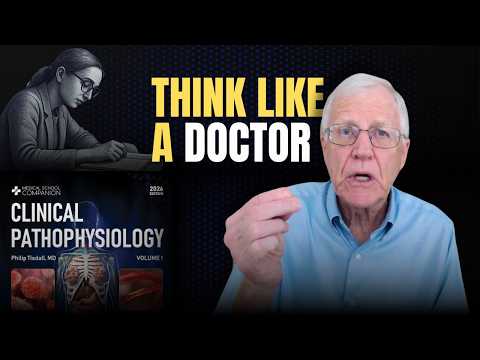
About this practice session
This page turns the YouTube video “How Doctors Think (And Students Don't)” into an English shadowing exercise. The recording is split into 760 short sentences that you can play one at a time, repeat after the speaker and record your own version for automatic pronunciation scoring.
The speaker talks at about 197 words per minute, a fast pace, with an average of 6.9 words per sentence. That makes it best for advanced learners; slow the playback down or loop each sentence at first.
How to practise with this video
- Play the first sentence and listen while reading the transcript. Notice the stress, the pauses and where the intonation rises or falls.
- Replay it and speak along with the speaker, copying the rhythm rather than reading word by word.
- Record yourself straight after the original. ShadowEcho scores each word for accuracy, fluency and completeness.
- Compare your recording with the original, retry the words marked in red, then move on to the next sentence.
- Practise 10–15 minutes a day. Coming back to the same video after a few days is an easy way to measure progress.
Transcript (English)
- when I see students learning
- when I see students learning
- I think the biggest mistake they make is
- I think the biggest mistake they make
- is they don't realize they're studying to be a doctor
- they don't realize they're studying to be a doctor
- they're so overwhelmed by their exams
- they're so overwhelmed by their exams
- everything is right in front of them
- and you just see them going
- and you just see them going
- exam coming up I've got to pass it
- exam coming up
- I've got to pass it
- and it's very hard
- and it's very hard with these exams
- with these exams and the volume of material
- and the volume of material
- not to have real anxiety
- not to have real anxiety
- I think the biggest challenge I face
- I think the biggest challenge I face teaching students
- teaching students is their deep
- is their deep underlying anxiety
- underlying anxiety
- because anxiety makes you go to ritual behaviors
- because anxiety makes you go to ritual behaviors
- and one of those ritual behaviors is memorizing
- and one of those ritual behaviors is memorizing
- why do students struggle
- why do students struggle
- when they feel that they're working hard
- when they feel that they're working hard
- why do students insist on memorizing
- why do students insist on memorizing
- how do doctors think through patient problems
- why is everything
- why is everything that I teach
- that I teach centered on pathophysiology
- centered on pathophysiology
- what do we say to medical students who are failing
- what do we say to medical students who are failing
- why am I wrecking my personal life to do this
- why am I wrecking my personal life to do this
- in today's video
- we're going to address a number of topics
- that keep coming up in the letters that you send us
- and they're important topics
- I see it every day
- when I'm teaching my medical students
- any one of these could be an hour's discussion
- but I want you to be aware of these subjects
- and at least make an introduction to them
- before we get further into this
- a number of you have not subscribed to my channel
- every week
- we're posting videos on how to help you learn medicine
- do yourself a favor hit that subscribe button
- why do students struggle
- when they feel that they're working hard
- well there's a general truism that I use
- performance equals talent times effort
- times directed effort squared
- so most of the time
- when students feel they're trying really hard
- one of two things is true
- they're kidding themselves
- that that's what trying hard looks like
- and No. 2 is that they're not studying effectively
- so let's talk about each of those in turn
- everybody has different rhythms through the day
- I'm an early morning person
- so when I have to learn something
- much better for me to get up and start at 8:00
- and study for the two hours until ten
- and then I can go on to other activities
- everybody's different you have to learn your own body
- so when you say when do you learn the best
- don't confuse learning something new
- with reviewing something that you already know
- when you're learning something new
- that learning has to be really active
- if you don't have a pen and paper
- and you're not taking multiple sources
- and you're not creating
- this is how I'm going to think about it
- and you write it down
- and then you know what proves you're learning it
- you have to turn that piece of paper over
- and see if you can do it yourself
- so let me give you a practical example
- when I assign you something from my book
- you'll see my book is mostly figures
- and tables and algorithms and
- I tell students
- there's only one reason I give you a table
- because you clear the contents into blank spaces
- you fill it in that's active learning
- and then the second part is
- you have to be able to come back and do it again
- tomorrow so when you've studied today
- you go these are my notes
- I can do them at the end of my study period
- when you start the next day
- you take out that blank piece of paper
- and you prove that you still got it
- in other words you gotta repeat
- it's really hard when you've got active classes
- there's a ton of material
- you have to be absolutely ruthless
- so when I was going through med school
- I actually studied in the law library
- because I didn't know anyone
- and people would come over and be friendly
- and I'd say thanks for the invitation
- but I don't want to know you
- because I can't afford to be social right now
- so I blocked off my learning period
- I got the notes that I knew I had to learn
- and I ruthlessly decided
- I'll learn this and I won't learn that
- and then I came out of the end of that study period
- with my notes
- and then I practice them at the end of the time
- and I started them the next day
- you watch how people are studying
- they're socially interacting
- they've got earbuds on you know
- the proof that someone's not learning
- they highlight
- nothing proves you're not learning effectively
- than highlighting cause you know what that says
- you know what I'll learn that tomorrow
- so you've got to go to class
- or however you're getting your material presented
- and you've got to take active notes
- that's a third of your learning
- you're not sitting back with your coffee going
- you know I'll learn this tonight
- there's no time so you have to be ruthless
- you go to class you say
- this is what I'm going to learn that evening
- you sit down and you say these are my final notes
- you finish them and then you say
- blank piece of paper good
- prove that you know that
- the second part is the directed part
- I know that medicine is built on pathophysiology
- so make sure when you're making your notes
- you take the book and you say
- what Doctor t said all that other stuff is fine
- but you've got to have this core
- pathophysiology to hang it all on
- so go get your notes go get other sources
- but make sure you can do the pathophysiology
- why do students insist on memorizing
- well the first thing to understand is
- students have been trained through their university
- to study for exams
- so when you say how are they trained to do that
- well memorize for the multiple choice
- wink wink
- the professor will often tell you
- a couple of questions on the test
- learn that material pass that test
- move on to the next thing
- it's hard to recognize when you come to medical school
- that's just not true anymore
- you're not passing exams to pass exams
- you're actually training to be a doctor
- the problem is they start medical school with Phds
- who still believe that you're an undergrad
- it's hard for Phds to understand
- you're not teaching biochemistry
- you're training doctors
- and it's a constant struggle in every medical school
- because most of the clinicians
- actually aren't very good at their basic sciences
- they never knew much to begin with
- and they certainly haven't improved
- since they've been in practice
- so the clinicians aren't gonna teach you that
- and the Phds control the early years
- so we have this terrible gap
- in which we're learning subjects
- in the old undergrad system
- of multiple choice questions
- check the box move on
- I'll give you a good example
- today I'm doing a course
- and part of what I'm doing is thromboembolism
- for the first year students
- and so I pinged one of my colleagues and said
- have we reviewed coagulation
- can I assume they do that
- when I'm teaching Virchow's Triad
- and she said oh yes
- we've done that but there's no harm in repeating it
- and I thought to myself
- what do you mean there's no harm in repeating it
Showing the first 200 of 760 sentences. Open the practice tool to go through all of them.
The original video belongs to its creator: watch it on YouTube.
More English shadowing practice
- How to Talk About Football in English | Easy English Podcast For Beginners
- Get Fluent English without leaving your country
- 100 Daily Routine English Sentences | First Words for Babies | English Vocabulary for Beginners
- The Matrix [ 4K - HDR ] - Neo Meets Morpheus, Blue Pill or Red Pill (1999)
- Listening + Speaking: The 2 pieces you're Missing
- DATING | Intermediate english podcast